

Listen, I’ll start with the obvious: someone died there.
And sure, that could be the clear conclusion here, but I have my doubts.
Around 2001, my parents bought a cabin that sat empty for years and was foreclosed on. Our new-to-us place had horrible, stale mildew smelling shag carpet, a wood burning stove, rotting deck boards, and one shower with a trick handle where hot was cold and cold was hot. We had to walk to a well for our drinking water.
This was not some thriving lake resort. It was a sleepy community with a few new builds and mostly retired farmers in timeworn houses. In fact, the oldest census records I can find are from 2006, with a population of 15.
I adored it.
Things didn’t get weird immediately. The things I can recall are mundane; the sounds of the house groaning, shadows that seemed to move, a fallen picture frame that felt like an ominous warning but became nothing. Easily explained by being young with an overactive imagination in a house in the dark country.
But then, when I was in my twenties, my parents decided they’d likely retire out there and the place needed a complete renovation.
Our cabin was now a fairly modern home.
And that’s when things got weird.
It started with my keys.
When I was 10, we went foraging through the local dump. I found an old frying pan, brought my loot home and painted it with a thick blocky lake, a squiggly sun, and a rainbow. It’s sat on our kitchen island for over two decades as the receptacle for loose gum, three lighters, a quarter of a joint and a flyer for a BBQ lunch that happened three years ago. It’s also where we put our keys.
It’s automatic. You come through the door, pass the kitchen with your arms full, toss your keys in the frying pan, and on to dump your bags in whatever bedroom you should choose for the weekend.
But it kept happening. Sunday morning would arrive, I’d have coffee with my family, pack my bags, go to unlock my car, only to find my keys were not in the frying pan.
Sometimes, they were on a shelf in one of the bedrooms. Once, they were jammed in the couch cushions. More than once, after turning the place upside down, they appeared in the frying pan. It was easy enough to explain away. With all our keys in there, maybe they’d blend in. Have a few too many beers on a Saturday and need to get something out of your car? Stumble back on in and forget to put them where they belong, put em’ on a shelf, or on the back of the couch where they slid down and between cushions. Fine.
Then the whispers started.
People trying to sleep at night, particularly non-believers and nay-sayers who had no idea of each other’s experiences, hearing their own names whispered in their ears while on the precipice of sleep.
Spooky, right? Never happened to me or anyone in my immediate family. But it did happen to guests who had no reason to lie, no background knowledge to draw on or be fearful of. One of them, a grown man, complete ghost denier and science head, refused to sleep in that bed for the rest of the weekend. He’s never been back.
Here’s where I’ll tell you again, that yes, someone did die there. He was an incredible friend, a chosen family member, and someone we loved very much. His passing was sudden and unexpected, a life-changing loss.
They say that, sometimes, spirits or energy lay dormant until the land where they reside is disturbed. I theorize this is what happened. The cabin doubled in size, completely changed the property, and we woke something up. Could it be him? Sure. He died on the land four years before the renovation. But I don’t think it’s him. Maybe it’s just that I don’t want to live in a world where his soul hasn’t moved on to whatever the fuck is after this. I don’t want him stuck, so I conveniently tell myself different stories.
You believe what you believe, I’ll believe what I believe, and together, we’ll see what we discover.
While historical detail is accurate, names have been changed for privacy.
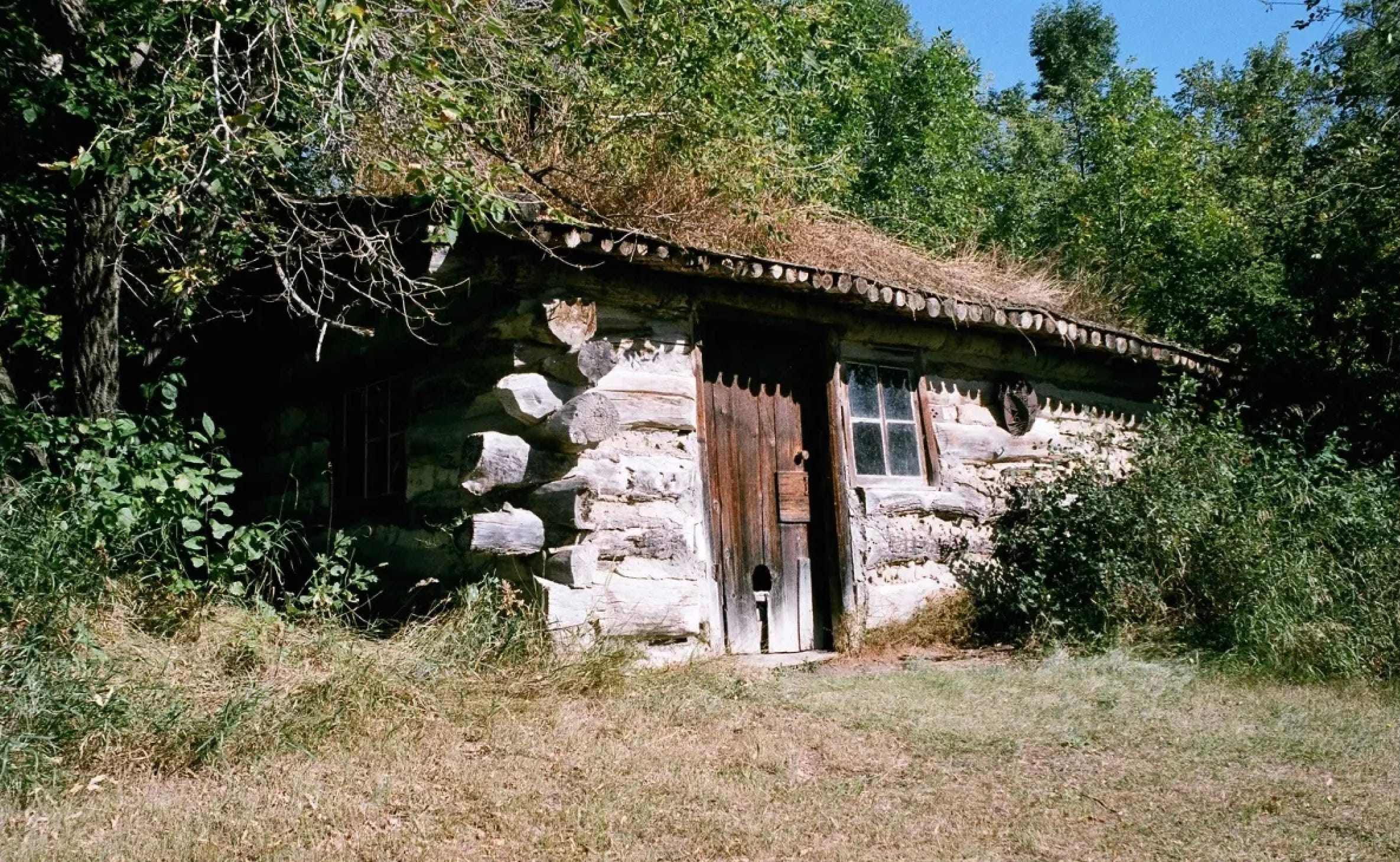
The hamlet of Henley Bay lies along the northern shore of Lake Langford, tracing its “beginnings” back to the early 20th century. Its story starts with pioneering settler Arthur “Red” Henley, a steam engineer from eastern Canada who arrived in 1903 and built a log cabin beside the springs of a coulee on what would become our cabin community. He completed the cabin the following year and chose to remain for decades, living by hunting and good ol’ self-sufficiency. His log cabin remains intact.
While it’s now harder to get to by land than it is by boat, I make an effort to set eyes on it every two years or so, though, my confidence is strong. I think most things built before planned obsolescence have a greater chance of continuing to stand than some of our modern homes.
The surrounding landscape was transformed in the 1960’s with the construction of the Langford Dam. The Dam had been a topic of discussion since the concept was first introduced in 1858. But construction didn't begin until the late 1950’s, and was opened in 1967 as part of Canada’s Centennial celebrations.
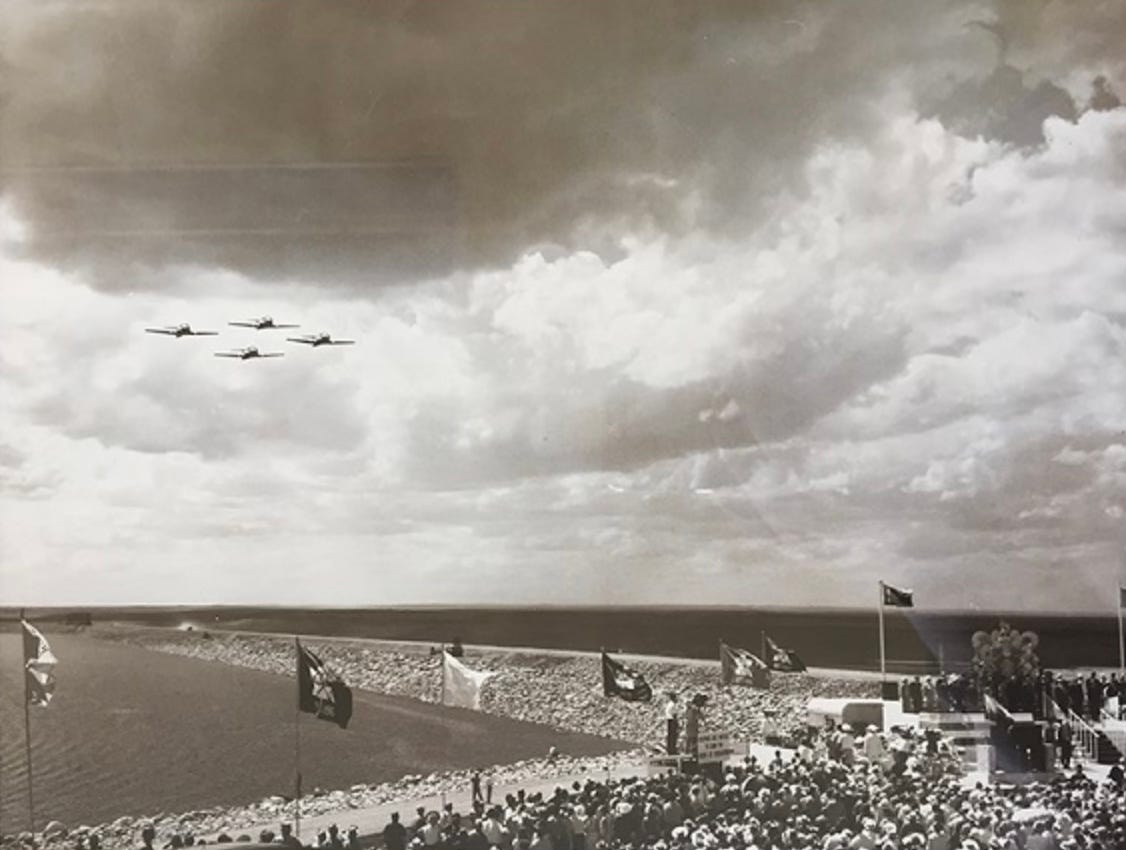
The Dam created a vast reservoir that flooded valleys and carved out inlets, bays, and stretches of new shoreline. The lake took shape, and trust, the lake is huge. It’s one of Canada’s largest artificial reservoirs, stretching roughly 225 kilometres long (139 miles). And all of that is very cool, indeed. But dam building is no easy gig.
In fact, dam building was one of the most dangerous forms of civil engineering. The work was riddled with hazards like unstable excavation walls, falling rock, flooding from diversion failures, heavy equipment accidents, dynamite misfires. You name it. By the 1960’s, safety measures had certainly improved, but fatalities were still not uncommon.
I’ve heard of deaths at the Langford Dam. It’s been uttered as fact in a number of conversations. People died building that dam, this, I thought I knew for certain. But I’ve spent the better part of the morning scouring library archives and newspapers.com, and I can’t find a thing. We can’t quite dismiss it out of hand, but we can say it’s not a compelling ghost theory.
Lakes themselves are dangerous. In the last few years, there’s been nine deaths I can account for on the lake, mostly drownings, one boating accident. Sprayer planes have gone down in nearby fields, pilots dying on impact. The occasional motor vehicle accident happens on the closest highway. Living is a reckless act, and things happen.
None of this has happened particularly close to our property.
History started long before white settlers. Arthur “Red” Henley brought its current name, but it had always been there, and so had many people.
Archaeological research tells us that the area now beneath the lake was once rich with evidence of Saskatchewan’s Indigenous peoples. According to A Thesis Submitted to the College of Graduate Studies and Research in Partial Fulfillment of the Requirements for the Degree of Master of Arts in the Department of Anthropology and Archaeology at the University of Saskatchewan1, at least twelve pre-contact habitation sites were identified, along with six contact-period settlements, marking the early years of trade between Indigenous nations and settlers.
The valleys and coulees later submerged by the reservoir were part of a complex cultural landscape. Campsites, hearths, stone tools suggest that the river was more than a travel route, it was a place of repeated dwelling, gathering, and ceremony over thousands of years. Artifacts bring memories of life to the valley: terraces and benches used for seasonal camps, ridgelines for hunting lookouts, sheltered coulees providing access to fresh springs and wood.
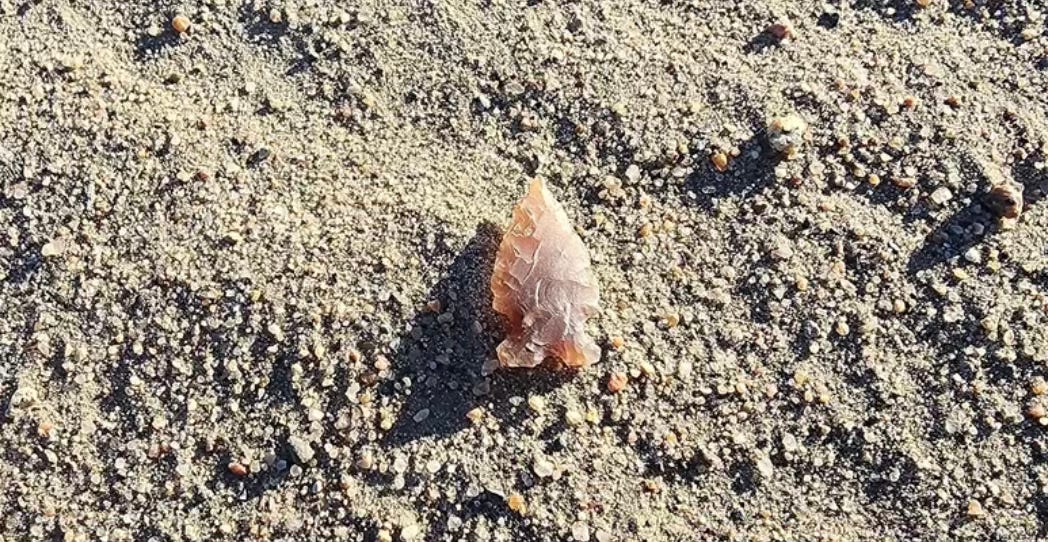
And I can attest, before the land in the hamlet was opened for new development around 2010, and the community was greatly expanded, we found endless arrowheads, scattered along the shore, especially after a hard rain. Now, with more people and traffic, those traces have mostly disappeared; pressed beneath gravel driveways and trimmed lawns.
These habitation sites spanned multiple cultures, including the Plains Cree, Assiniboine, and Saulteaux, among others. When the dam was completed, flooding inundated much of this historical record. Some materials were salvaged during emergency excavations, but many sites were and will remain to be lost beneath the water.
Alright, so, have we found the spirit that plagues us? Not really. But I’ll let you know, I made peace with this long ago.
In 2020, I took some time off to go to the cabin. One night, I fell into a sweaty, fitful sleep and woke in the dead of night with my throat completely dry. I stumbled from bed into the bathroom down the hall in the dark, and then out to the kitchen to get a glass of water. I never turned a light on, and I certainly didn't touch my keys that were, yes, settled and resting in the frying pan.
As I wandered back to my room half-asleep, my back to the large window overlooking the driveway, an incredibly bright light lit up the room behind me. I froze, and turned around with a slowness and hesitation that cannot be overstated.
The headlights of my car shone through the window and directly at me. The house was silent, the room was otherwise dark, I was alone.
I swallowed and waited. Eventually, the lights simply went off, and that was that. The house was, again, silent and dark.
I climbed back into bed, and spoke out loud to the air or whomever or whatever, “I know, I notice you, too.”
That will be exactly five years ago in two weeks and nothing has happened since.
If it did, that would be ok. Whatever’s been around, it’s never felt threatening. Off-putting at times, sure. But never bad. Just a thing. A thing that reminds me that we stand atop land that knows life and death the way it knows wind and rain and this is all going to come and go, and maybe we’ll be here again, and maybe we won’t. None of it is certain and yet it is completely so, and so I’ll be at ease with it no matter who or what it is.
https://harvest.usask.ca/bitstreams/44c68828-1bea-418c-82fc-d838ed4ada07/download