


The 150 BPM synthesizer kicks in, and the hair on your neck stands on end. Riding under the arpeggiated riff, the low, smoky voice of Robert Stack intones his ominous preview of the mysteries to come.
Then, as though reaching into your living room, he asks you, “…maybe you can help solve a mystery?”
So you stick around, riveted. I know I did!
I loved Unsolved Mysteries as a kid, and still watch hours of episodes in between the X-Files, The Outer Limits and whatever other weird fodder eBay or the crew brings to Friday movie night.
So when I spotted the 2023 documentary, Unsolved Mysteries: Behind the Legacy, I just had to watch it.
Terry Dunn Meurer and John Cosgrove are credited as the creators of the classic series, with some prior art in 1987 that laid the initial groundwork.
“The thing that sparked Unsolved Mysteries, as a series, was really a series of specials John [Cosgrove] and Terry [Dunn Meurer] had done for NBC called ‘Missing: Have You Seen This Person?’”, Raymond Bridgers, Co-Executive Producer, says.
“When we launched the weekly series in 1988, we had already produced seven Unsolved Mysteries specials,” co-creator Terry Dunn Meurer recalls. Recounting how initially the series didn’t receive a tremendous amount of support from the network.
In Unsolved Mysteries: Behind the Legacy, various team members also take time to reflect on the stories that had left an impact on them. Of note was the Cindy James case, discussed right here by the Queen of Story herself on High Spirits Vol. 7.
However, it was the segment on how the mysteries were discovered to begin with that I found the most fascinating,
It turns out it was a combination of human intelligence (HUMINT) and open source intelligence (OSINT), led by women.
Finding the Mysteries
“It’s hard for people to remember the tools that we had back in the late 80s and 90s for making television were so different,” Field Producer, Shannon McGuinn, is quoted as saying, “the research was a lot more difficult in finding stories back in the day.”
It is a true wonder to pause and think that this show that has captivated our attention for so long, largely conducted its research long before the Internet could lubricate its efforts.
The first and most obvious technique (yet still frequently overlooked or avoided) was cold-calling to local sheriff’s offices and newspapers.
“We divided up the country state-by-state and made contacts in those states,” Field Producer, Stacy Schneider reflected, “and when we hear of a good story, we’d call those contacts to help us flesh them out.”
The Unsolved team knew the value of local, human contacts to drive their stories. Those contacts would better understand local culture, have deeper experience with local sources (and potentially, the general veracity of those sources’ information) and possess their own local networks to tap into. The Unsolved team combined open-source intelligence with human intelligence, then repeated, refined, and deepened the research as needed.
The team also knew their audience and didn’t simply focus on murders and missing people, but included everything from Bigfoot, hauntings, and fraud to legends of lost treasure.
“We had over twenty different categories of mysteries,” Stacy Schneider recounts.
Diversity of story, locale, and topic kept things interesting. I can attest as a young child in the 80s watching the show — you really never knew what you were in for when you sat down to watch it.
With twenty categories and a hungry fan base, the Unsolved team employed another tactic. They scaled their open source intelligence gathering through outsourcing.
“Back in the days, before there was an Internet, the way we would find stories was through a clipping service”, Stuart Schwartz, Co-Executive Producer, states in the documentary.
“What they [the clipping service] did was they sent newspapers to people all over the country whose job it was to go through those papers - local newspapers - find stories in the categories that we sent them and literally cut those stories out of the newspaper and send them to us,” Schwartz further explains.
Well, this was a whole new thing to me.
What was a clipping service?
A Bit of News Clipping History
Turns out, about a full century before I was born, in 1881, a Latvian, Henry Romeike, founded a press clipping bureau in London. Romeike also invented the entire industry at the same time. The business bloomed along with the increased production of the printed word, and in 1887, Romeike set up shop in New York city advertising it as “the first established and most complete newspaper cutting bureau in the world”.1
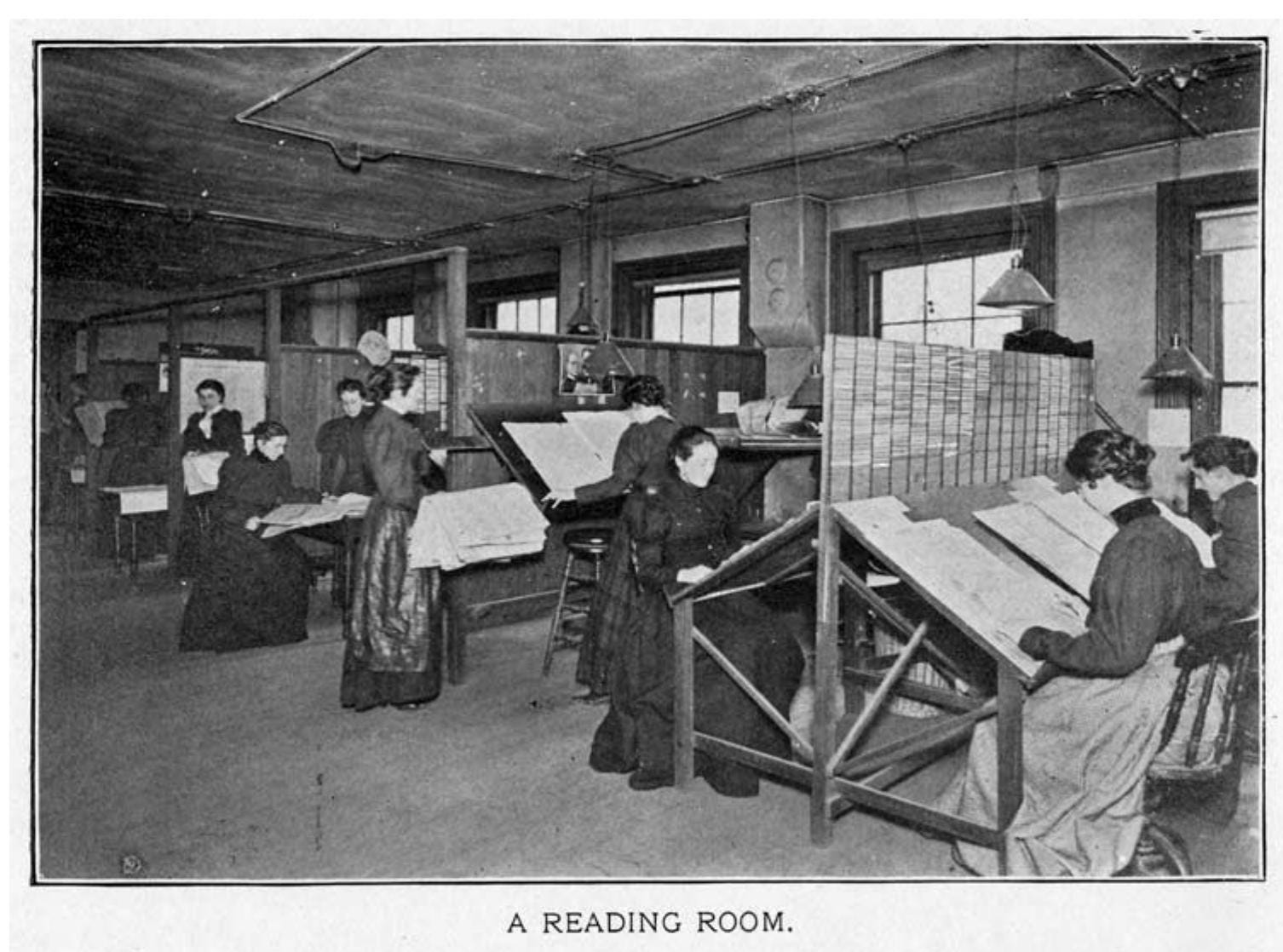
In 1888, Frank Burrelle formed Burrelle’s Press Clipping Bureau when he “overheard two businessmen lament the difficulty of keeping up with the news in the papers. Burrelle and his wife transformed their kitchen table into a press clipping bureau, pulling from New York City newspapers the news of interest to his customers.”2 Not far away, in Boston and in the same year, Robert Luce formed Luce Press Clippings, and 115 years later, in 2003, the two companies merged.
In 1932, Romeike was still rocking, and internationally so. An article published in TIME magazine provides an excellent view of what a Romeike clipping service looked like in Manhattan:
Not one pair of shears is visible when the Henry Romeike clipping crew is at work full blast in its Manhattan loft. About 60 young women sit at benches, expertly scanning the 1,900 dailies and 5,000 weeklies which have been sorted from great stacks of mail bags. (Newspaper subscriptions are a bureau’s largest expense excepting labor.) Pasted on a wall before each girl’s eyes is a typewritten list of clients and subjects most difficult to remember. The bulk of the 7,000 names and words for which she must watch is carried in her head. - The Press: Clipping Business, TIME Magazine, 1932.
What I found a bit…odd…when reading up on some of this history was the notion that the mental loading of keywords, rapid ingestion of information and the analytical judgement call of when to include or not include something was considered “feminine”.
While the more “manly” job was to do the actual paper cutting and gluing.
That’s right, lads, you just head on over to the clippy-gluey part of the factory floor while the ladies do the thinking and reading.

Clipping services are also often considered to be the predecessor for the concept of data mining, or the process of taking large amounts of data, analyzing it and then applying algorithms to try to uncover patterns within that data3. The more modern association to data mining of course, is its darker uses in advertising, marketing and surveillance technologies.
Turns out, like so many other things, the ugly side is just not that modern.
The TIME article continues with, “As everyone knows, the function of a clipping bureau is to supply customers with clippings from newspapers everywhere mentioning either their names, manufactured products or any designated subject.” The unnamed author goes further to publicly out some of the Romeike clientele, “….General Electric, R. C. A., N. B. C, Owen D. Young, Edward A. Filene, Cornelius Vanderbilt Jr., cigarets, oranges, electric lights…” The list went on from industrialists to powerful politicians and more often, simply the rich and the vain.
Dual-use services are always an ethical struggle: on one side, they can be used for targeting of humans for consumption (or, kinetically, for that matter) or the development of surveillance technologies of all stripes and shapes. While, on the other hand, these same information services can provide entertainment, enlightenment and even save lives.
Same paper, same markers, same scissors, same glue.
Metaphorically speaking.
Naturally, these clipping and monitoring services were an ideal solution for media companies hungry for interesting and local stories. The more that radio and television broadcast technologies grew, the more the need for finding interesting content and stories grew alongside it. Feed the consumer demon their content and then shove products in their mouths when they open them to take a breath.
This all left me wondering: did the woman-led clipping services, that is, the very collectors and synthesizers of monitored topics, include hidden bias that tipped the stories towards women, the end consumers of those same media? Just like racial and gender bias creep into machine learning and large language models?
Is it that women made great storytellers and selectors of quality stories for TV production? Or was it due to arguably sexist and misogynistic labour practices at the industry’s inception point that ultimately drove women to work on one end of the factory floor vs. the men doing the clipping and gluing?
What about today? Well, one article published in October 2025 in the British Journal of Psychology4, had this to say:
While fictional violence and horror are preferred by men (Clasen et al., 2020; Martin et al., 2019), this is not the case for the true crime audience…[r]esearch has established that the vast majority of true crime consumers are women, with numbers ranging from 70% up to 93% (Boling, 2023; Boling & Hull, 2018; McDonald et al., 2021; Vicary & Fraley, 2010).
…
One theory suggests that female true crime consumption is driven by defensive vigilance, as women seek information and knowledge about anxiety-eliciting, dangerous situations to better anticipate and prevent real-life dangers (McDonald et al., 2021; Vicary & Fraley, 2010). Indeed, research on crisis and risk communication shows that women conduct more risk information seeking than men (Lachlan et al., 2021; Manierre, 2015), which for one, may join into the need for uncertainty reduction and link back to morbid curiosity.
“Out of the dark – Psychological perspectives on people’s fascination with true crime”
Could it be that, given women’s continued consumption of true crime, the women analyzing the raw data were doing more than simply providing upstream mysteries for media producers?
Maybe these analysts were making sure that all of the other women around them were aware of the dangers that lurked for their gender specifically.
Wouldn’t that be a good thing?
Is there such a thing as a “good thing” in data mining or intelligence gathering biases?
I don’t know. Call Robert Stack. More questions than answers as usual.
What I did learn from the women of Unsolved Mysteries is that a holistic, collaborative, iterative, empathetic approach to research and investigations lays the perfect foundation for a great final work product.
Whatever its use may be.
Henry Romeike Clipping Scrapbook | NMAH.AC.0338 | SOVA, Smithsonian Institution, Si.edu. https://sova.si.edu/record/nmah.ac.0338
BurrelleLuce Company History. Archived. https://web.archive.org/web/20151223122322/http://www.burrelles.com/company/history
Definition of Data Mining, Science Direct. https://www.sciencedirect.com/topics/earth-and-planetary-sciences/data-mining#definition
Perchtold-Stefan, C., Rominger, C., Ceh, S., Sattler, K., Veit, S.-V., & Fink, A. (2025). Out of the dark – Psychological perspectives on people’s fascination with true crime. British Journal of Psychology, 00, 1–30. https://doi.org/10.1111/bjop.70038