

Before you start wondering, let me spoil the fun. At Bullshit Hunting, we’re not mystics or supernaturalists. We are, however, endlessly curious.
A few posts back, Justin told you he’s been building up our archive of paranormal and occult materials. We’re not going to start reciting spells or casting out demons, but we will be graphing our way through particular spiritual movements and moral panics that fascinate us. Mostly for the hell of it, pun intended.
It will come as no surprise to some of you that when you start to comb through these materials, there are a few regulars who haunt the pages. And two of those people are Ed and Lorraine Warren. We plan to tell you more about Ed and Lorraine as we learn it, but until then, I’d like to introduce you to a crash course for the uninitiated.
You might know Ed and Lorraine like this:
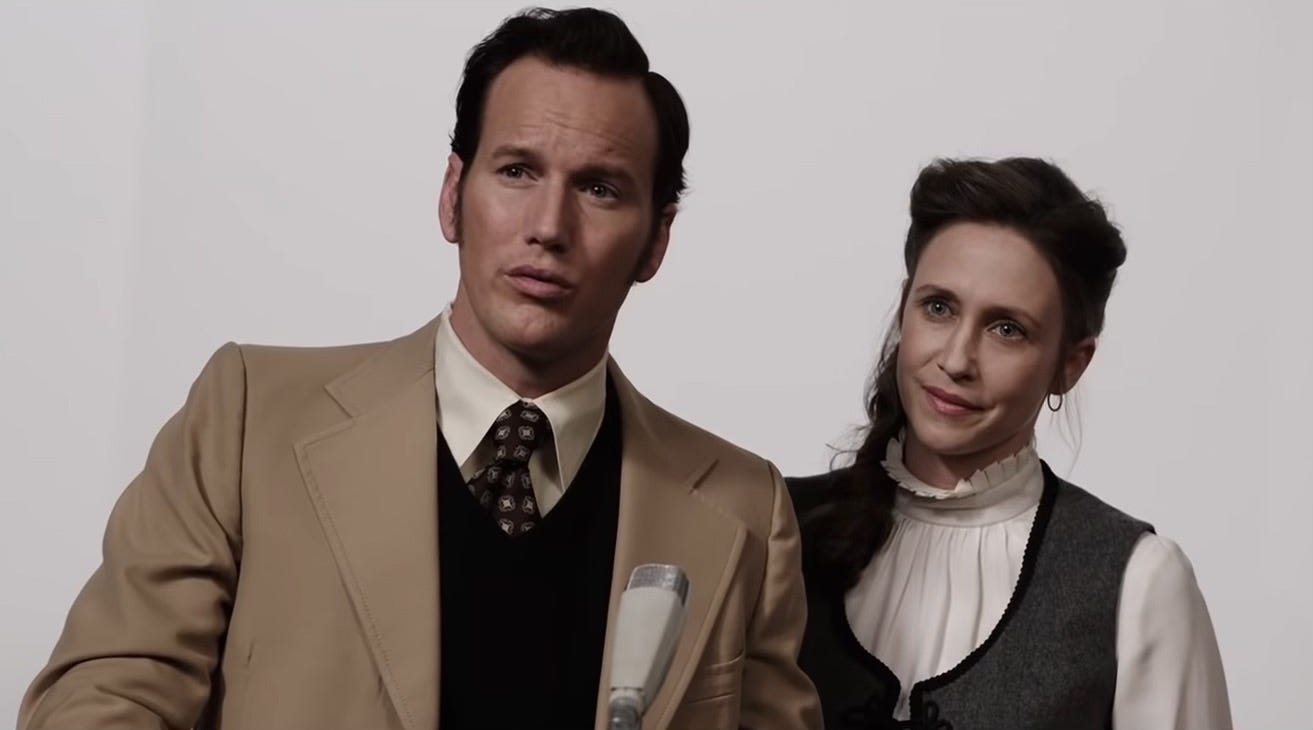
Between 2013 and 2025, Warner Brothers released 10 total movies in The Conjuring universe, which was created from “Ed and Lorraine’s case files.” Five of those films featured Patrick Wilson and Vera Farmiga as a wholesome, attractive rendition of Ed and Lorraine Warren.
The actual Ed and Lorraine:
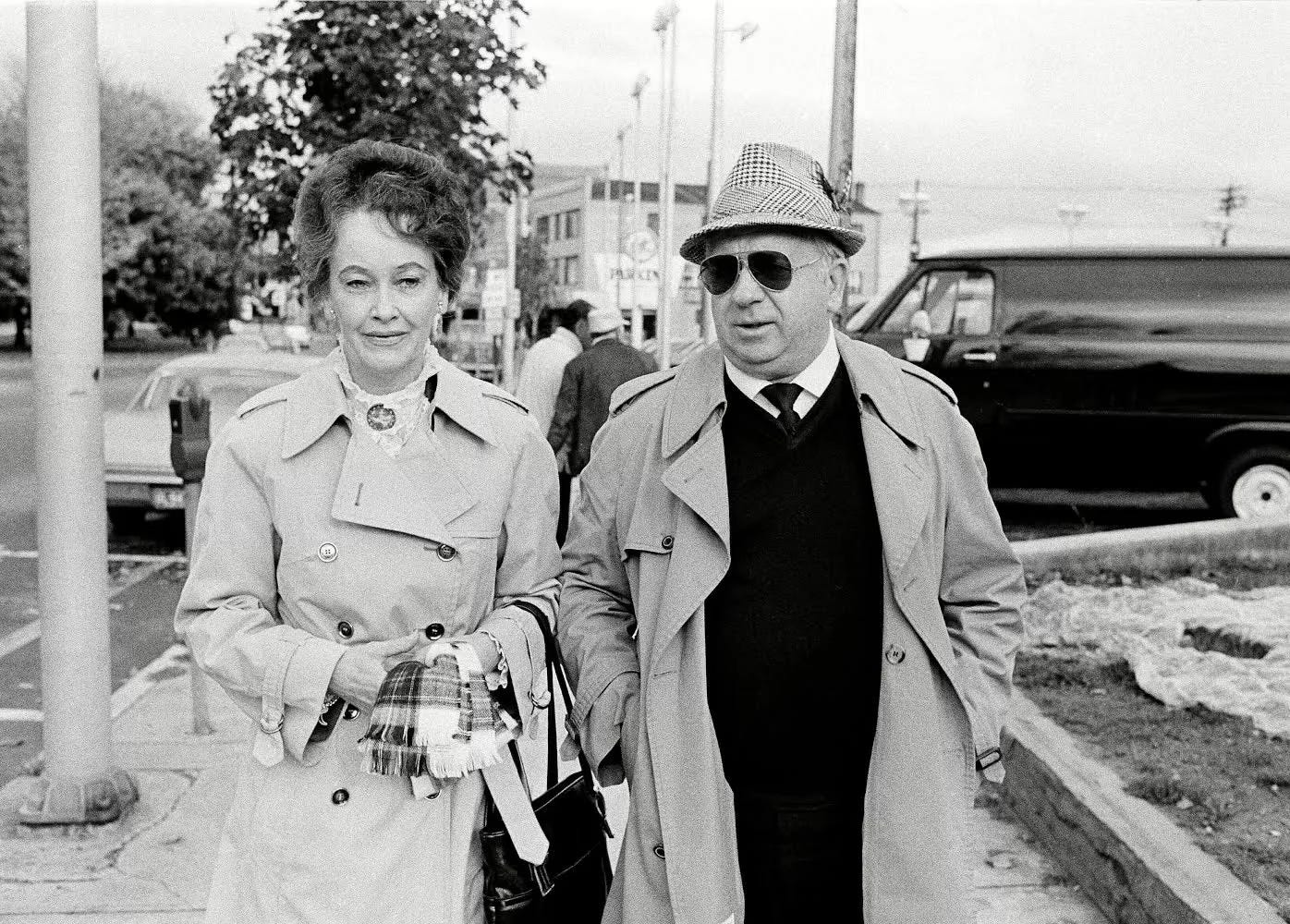
If you think you’re unfamiliar with them, just wait. Simply living in society, they’re hard to miss.
Ed Warren Miney was born in Bridgeport, Connecticut, in 1926, to a strict Catholic family. Ed’s father, a furnace repairman, attended daily mass. That’s the level of Catholic we’re dealing with here. The family lived in a home that Ed claimed was owned by a frightening spinster-landlady. She had all the makings of a great ghost in living form. Until she died. Then she was just a great ghost in ghost form.
At the age of 5, while playing in his room, Ed’s closet doors flew open, and a small glowing light grew into a transparent and displeased frowning apparition of the landlady. Then, she disappeared. This, and Ed’s recurring dreams of a nun who declared herself to be his deceased aunt, were the supposed catalysts for his lifelong obsession with the paranormal.
At the same time Ed was growing up in his haunted house, Lorraine Moran was born. She was born in 1927, about three blocks from Ed’s family. Around the age of 7, Lorraine started to see things. Once, in a hospital, she saw a being she believed to be an angel. By the age of 8, she could see auras radiating from people’s energy. Also Catholic, Lorraine believed these were God-given abilities.
Ed and Lorraine met in 1944 when Ed was working as an usher at a local theatre, and the two were married by 1945 while Ed was on leave from the Navy.
By the late 1940s or early 1950s, Ed and Lorraine were finding their paranormal footing in what I can only call a strangely invasive, convoluted way. Both fascinated by spirits, and both hopeful artists, when Ed and Lorraine heard reports of active haunted houses in the newspaper, they’d stand outside the home, across the street, and sketch it. When they finished with the sketch, they would knock on the door of the homeowner and tell them that they could have the sketch in exchange for information about the haunting.
If there was enough interest, Lorraine would take the sketches to paint them. Some of these haunted house paintings were sold at art auctions, generating enough interest for Ed and Lorraine to begin launching their careers as paranormal investigators and demonologists.
In 1952, before the paranormal revival of the 70s, the Warrens founded the New England Society for Psychic Research, NESPR. A mostly untapped market, word soon spread of this supposedly impressive organization in Connecticut that would listen to your claims of paranormal activity and demon possession, and listen seriously, when no one else would. The calls started coming in.
The business was essentially a traveling demonology-themed intervention service. Ed called himself a “self-taught demonologist” with no formal theological or investigative training, while Lorraine identified as a clairvoyant, more commonly referred to these days as “a medium.” Together, they offered to diagnose hauntings, perform blessings, declare demonic activity, and advise on exorcisms. Their work revolved around collecting personal accounts, attributing distress to supernatural causes, and removing objects they deemed “cursed,” many of which they added to their privately run Occult Museum. Their primary “service” was not investigation but the framing of family crises, mental health struggles, domestic instability and abuse, or environmental stress as some cosmic battle with malevolent forces. Or whatever, maybe it was demons.
The Warren’s claimed involvement in the 1971 Perron family haunting in Rhode Island, later dramatized as The Conjuring. The now-infamous 1974 Amityville Horror, a case that became one of the most profitable and sensationalized hauntings in American pop culture; the 1981 “Devil Made Me Do It” murder defence, where demonic possession was offered as a legal argument; and the late-1970s Enfield Poltergeist in the UK. These high-profile cases, and the ways the Warrens later portrayed their roles in them, became the backbone of their mythos.
It’s during this time that the webs and graphs become very interesting.
Cultural phenomena and moral panics are not tidy, simple events. They are the culmination of factors playing together to create a specific alchemy. They rely on timing and the messy convergence of fear, shifting values, and the promise of something tangible beneath it all. In the 1950s, belief in the supernatural wasn’t widespread, but the conditions for a paranormal boom were beginning to simmer: the rise of fundamentalism, televangelist empires, the Catholic Church’s resurgence of possessions and exorcisms, growing distrust of institutions, and an eroding confidence in traditional values with major and minor revolutions. Mix in the explosive religious horror, The Exorcist in 1973, and the Warrens’ had an eager audience.
Now, the issue, you see, is that the eager audience wasn’t necessarily the same folks Ed and Lorraine claimed to be helping. They grew in popularity not because desperate families were unanimously calling for demonologists, but because America itself had become primed for supernatural spectacle.
A pattern emerges across decades of their involvement: the Warrens often appeared uninvited, or with minimal participation that they later inflated into heroic interventions. Families and investigators regularly reported that the Warrens spent only a few hours on-site, or barely spoke with them at all, only to watch books, interviews, and lecture tours retell the story as if the Warrens had been central figures in the case.
This wasn’t an isolated incident. Time and again, the Warrens inserted themselves into cases where they were not wanted, often heightening the fear and confusion of already distressed families. Instead of offering clarity or comfort, they frequently introduced the idea of demonic possession, an escalation that, in many cases, made situations far more traumatic. Their “help” often meant telling vulnerable people that their home was under attack by something infernal, and that only the Warrens possessed the authority or knowledge to confront it.
The more sensational the story, the better it played on television, in magazines, or in one of the countless ghost anthologies of the 70s and 80s. And so the Warrens kept appearing, sometimes uninvited, sometimes unannounced, positioning themselves as experts while leaving behind families who were now not only frightened, but also entangled in media attention, fear, or outright exploitation.
Whether or not the Warrens had any actual abilities is not something I’m interested in debating. Ed passed in 2006 and Lorraine in 2019. They can no longer explain. And ultimately, I’m not invested in the same belief systems it would require for me to see the value of their “services.”
What I do know for certain is that movies and media have portrayed a loyal, loving and God-fearing family of do-gooders who I fear likely did not exist.
We will continue to acquire more information about the lesser-known inner workings of the Warrens, their “colleagues” in spirit cleansing and demon banishing, and dole out those tasty morsels of reality when the timing seems right. For now, a few appetizers.
Ed and Lorraine’s Occult Museum in Monroe, Connecticut, home to Annabelle and dozens of allegedly dangerous artefacts taken from haunted residences, supposedly containing demons or negative energy, was never opened to independent investigators for examination. The collection operated without formal documentation or external review. The museum was eventually shut down in 2019 due to zoning violations, as it was on a residential street behind Ed and Lorraine’s former home.1
The issue of documentation extends to the Warrens’ casework. Authors who collaborated with the couple have said that records for major investigations were sparse or inaccessible and that some files appeared incomplete or entirely absent.2 Their methods seemingly relied heavily on Lorraine’s intuitive impressions and Ed’s demonology framework rather than standardized investigative protocols, environmental measurements, or evidence. As a result, many of their most famous cases lack the material record typically expected of formal investigations.
One of the most puzzling allegations was made by Judith Penney, who stated in sworn testimony that she entered into a relationship with Ed Warren when she was 15 and lived with the couple for decades.3 The Warrens, according to her, presented her as a niece or a poor girl they’d taken in. In May 1978, in her 30s, Penney became pregnant with Ed’s child, she said. In the declaration, she said Lorraine persuaded her to have an abortion because the birth of a child could become a public scandal. Penney said Lorraine’s “real god is money.” These allegations have never been responded to in a meaningful way.
I cannot stress enough, this is alleged. But we’ll keep looking.
https://westportlibrary.libguides.com/WarrenMuseum
Radford, Benjamin. Investigating Ghosts: The Scientific Search for Spirits (2017)
https://www.hollywoodreporter.com/tv/tv-features/war-conjuring-disturbing-claims-behind-a-billion-dollar-franchise-1064364/