
The Ghosts of New Tech
Or, how little data points may or may not be people



On a grey Sunday afternoon, I send Justin a text.
Do you want to see something scary?
Immediately, he writes back an unequivocal no.
And it’s important, folks, that when someone says “no,” you listen to them.
Unless, of course, that person is your business partner and you have something that needs to be seen.
Too bad, I write back, and send it anyway.
I woke that morning and decided to take a drive. Along the river that runs through and out of our city is a conservation area with a few kilometres of walking trails; a scenic delight in the summer and fall. In early April? Less scenic.
I wasn’t surprised to find myself pulling into an empty dirt lot.
You have a 10-ish minute walk from that parking lot to the beginning of any real trail, and it’s rare that the area isn’t filled with people and dogs, or families deciding which route to take. So, I laced up my boots and savoured having the wide open field to myself.
Eventually, I met the beginning of a boardwalk and, inspired by the mere thought of everything coming to life in spring, took a photo.
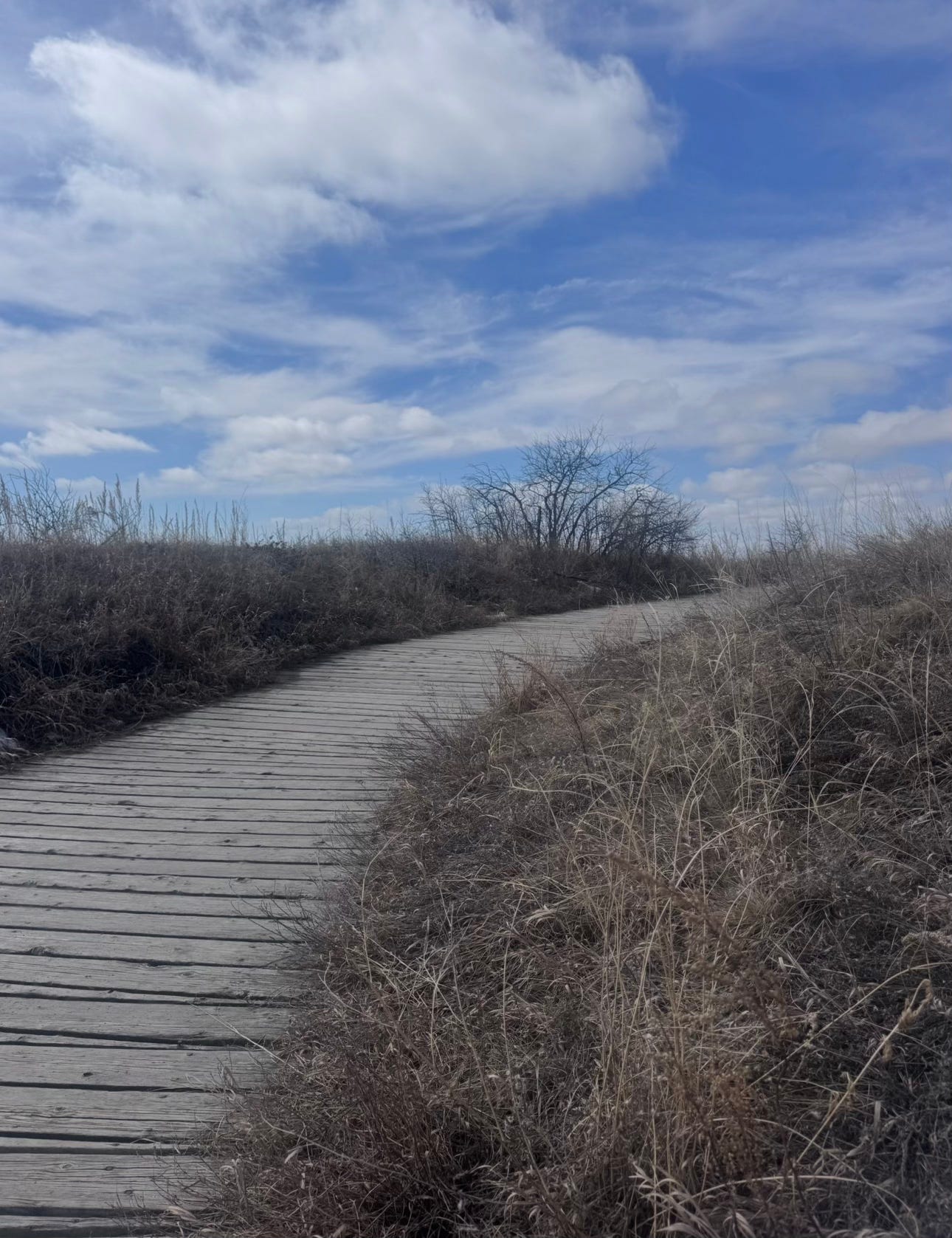
The clouds were shifting to reveal blue sky and sun, and when I rounded the corner, I found myself overlooking a valley of trails.
Disappointing but unsurprising, many of the trails were still covered with melting snow or washed out by muddy water. They looked like a nightmare to trek through. But I was already there, and there was no one else in sight; should I try my luck and fall on my ass, there would be no witnesses. So, with my headphones now on, I went forward.
I don’t know what I was thinking about; I just know I wasn’t really listening to the podcast when I heard what sounded like a man’s voice behind me. I stopped and lowered the headphones from my ears.
It seemed the world was entirely silent aside from my own breathing.
I waited a moment to see if another noise would come.
Nothing.
15 minutes later, mud-covered and damp, socks thoroughly wet, I began to curse myself when the sound came again. This time, it sounded closer and louder. I flung my headphones down my neck. Now, I was on higher ground, and in the silence, I could see the trails around me were still empty. I spun every which way, but I could see no one, and aside from the rustling of branches, I heard nothing.
Fool me once, meh. Twice? I’m out.
Half an hour later, I was through the trails and heading back to the parking lot when I realized I was about 1.2km short of my goal. At that point, I had two options. I could do a lap in a bare field to my right or take a small trail through a wooded area to my left. Having just seen a family and more vehicles pulling in, I turned to the left, sans headphones.
Branches cracked under my feet, birds chirped, and the sun fell behind the clouds again.
Then, with nothing between my ears and the air, a booming and incoherent male yelling came from not so far away, and I pivoted on my heel. I don’t know who it was, I don’t know where it was. I don’t really care. Fuck that last half a kilometre.
Later that afternoon, I opened the photos on my phone. Because my phone is just a few years old and new technology is engineered to become obsolete, the camera is starting to show its age. No matter how clean the lenses are, photos in natural light come out with a haze. It’s annoying, but most of it can be fixed in the same editing app I’ve been using for years.
Let me stress that again: the same editing app I have been using for years.
When I edit my photos, I’m primarily adjusting the lighting. Like so:

Now, in the photo of Mochi the cat, it may just look like colour grading (a filter). But in the cafe photo and the corner of my kitchen, you can see the addition of shadows and highlights that weren’t originally there, because the app is using local tone mapping to adjust different sections of the photo independently, lifting highlights in areas that would naturally catch light and deepening shadows where light would fall off.
It creates the illusion of a directional light source to create more depth.
Very helpful in areas with low lighting or little to no natural light.
I pulled up the photos I’d taken on my walk and popped them into the editor. Given the issues with my barely geriatric camera, and the fact that the photos were taken outdoors, they were all too low-contrast to really spend time on, but I decided to try with the boardwalk.
I scrolled through the lighting options and clicked one titled “midday.”
Imagine my surprise when it presented me this:
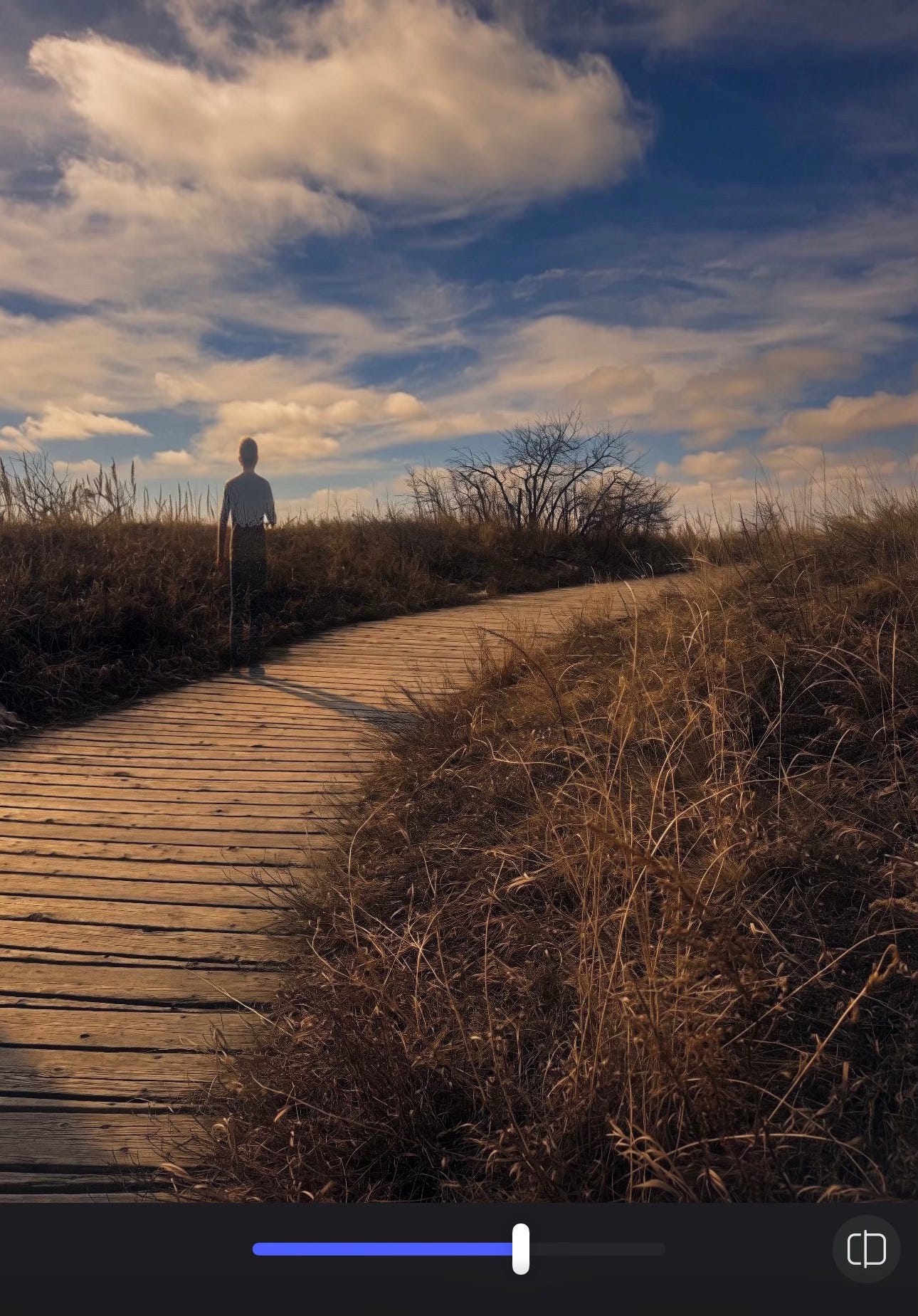
I can assure you, that has never happened before.
The creation of an entire entity has never been part of the editing process.
After my walk full of disembodied mysterious yelling, the sudden appearance of a transparent… young man?… was certainly not the soothing lighting improvement I was hoping for.
My immediate, and admittedly flawed, first thought was that the editor was picking up something I couldn’t see. If it increases highlights and deepens shadows, then it had to be mapping something.
I deleted the photo from the editor, added it again, and it did not happen. I could not recreate the boy.
Before this, I hadn’t given much thought to what the app was doing.
Traditional lighting adjustments play with exposure, contrast and white balance. Basically, there are mathematical changes to the pixels. Pretty simple.
Newer technology is different. Instead of changing pixels, the app is using generative AI-assisted relighting and scene completion. It’s changing the content rather than the grading, and under certain adjustments, it can create plausible elements based on patterns it’s learned. In photography datasets, a boardwalk path, horizon line, and open field may often be accompanied by a figure. So it placed one there.
Spooky in theory, not so much in actuality, these ghosts in new technology.
When I sent the photo to Justin, he gave me what I was looking for. A solid “What the fuck?” and a few other choice words and adjectives.
I didn’t feel too bad about bulldozing his earlier “no,” because it had it’s intended effect, and sometimes, I think the universe brought us together primarily to freak each other out.
Recently, Justin has been immersed in a case that required comprehensive scene analysis.
He did a fascinating remote crime scene walkthrough with a wicked forensic scientist using high-resolution laser scan data. I was not there, but I have the recording, where we’re looking at the scene as if we’re standing inside it, just digitally reconstructed.
In certain areas, you can see what seems to be the shape or mass of a person made up of tiny white dots, no discernible solid features. The laser scanners sit in one position and rotate, sending out pulses of light and measuring how long they take to bounce back. Over a few minutes, the device collects millions of points to build a full 3D map of the space.
If someone walks through while that’s happening, they’re only captured in fragments depending on where they were in the moment. Since the software stitches all those moments into a single model, the moving person doesn’t resolve into a solid figure. Instead, they appear semi-transparent, duplicated, or partially missing, like a ghost passing through the scene.
I’ve watched the video a dozen times or more, and it never gets less eerie to pass by one of those “ghosts,” even when you’re aware it’s just authorized personnel on scene.
Whether it’s a trail in early spring or a reconstructed crime scene rendered in millions of points, your brain and the technology are functionally doing the same thing: trying to resolve something incomplete into something whole. A shadow becomes a person, a distant sound becomes a voice.
A flicker of movement between trees. A cluster of pixels where a person might be. A smear of light that looks just enough like a body.
So maybe there was no one on the trail that morning. Maybe the yelling was just sound carrying strangely through wet trees and open space. Maybe the app stitched together something it thought belonged there because, statistically, it often does. Who knows.
I closed the app, but I didn’t delete the photo because even though it didn’t capture anything truly frightening, for a moment it felt like it did.