


I was in another country recently, and close to my temporary abode was a small restobar that had been around for decades.
On the same table every day was a lazy orange cat, the same waitresses serving mostly beer of their choice, taking your order as a mere suggestion, and the same people taking up the same spaces every morning for a delicious and woefully underpriced breakfast.
I was sipping a Corona on a barstool one afternoon when a friend pointed out the owner of the bar. He was a big gentleman, with a ruddy face and thick sausage fingers. When I turned to look at him, he was bending over the stroller of a maybe-2-year-old who smiled up at him, babbling away happily. They made faces and noises to one another, and the man grinned a genuine grin, and laughed a laugh that shook his entire belly.
It was a fine scene. Happy owner, happy baby and mom, sharing some joy in the dopey afternoon heat.
I couldn’t help but notice though, and make a comment to my friend about the owner who was clearly and evidently drunk at 1pm in the afternoon on a Monday.
“Oh yeah, he’s a drunk. Always has been,” shrugged my friend, who had been coming to this exact spot for over ten years, “But he’s harmless. Super nice guy.”
“What a way to live. Get up every morning to run your bar next to a beach, drink beers with your neighbours all day. Can’t imagine he’ll live forever, but it doesn’t sound too bad, does it?”
My friend laughed and tipped his beer toward where the bartender was standing with a different group of people. Everyone in that circle looked undeniably happy.
“That guy has community. Every day, he’s surrounded by people who he loves, they love him. He smokes cigarettes and eats terrible food and drinks every day, but he’s truly happy. He will live longer than any miserable vegan with no friends.”
(Disclaimer: I was once a miserable vegan, I love ya’ll. And alcoholism is not a better option as far as life choices go. I don’t recommend or endorse.)
For one gut-clenching moment, as I took in this room of people genuinely enjoying each other’s company, I thought of my empty condo. I thought of how, in a few days, I would board a flight back to the frozen tundra and get in an Uber to go home, alone, where it would be dark and quiet and startlingly different from here.
The reality of life is one of routine and security. I have a home that I work and live out of. I go to yoga a few times a week, I take long walks, sometimes I pop into coffee shops, take myself out for a glass of wine or to a play at the theatre. It’s rare that my week doesn’t include at least a few sets of plans with friends, which usually entails settling into my couch or theirs to catch up on the relentlessness of living.
I like my life. I’ve constructed it well, and it’s a nice place to be. I also find myself in my therapist’s office every couple of months lamenting about isolation, struggles to be in or find community at this exact juncture of life.
I turned to my friend on our barstools.
“Have you heard of The Third Place?”
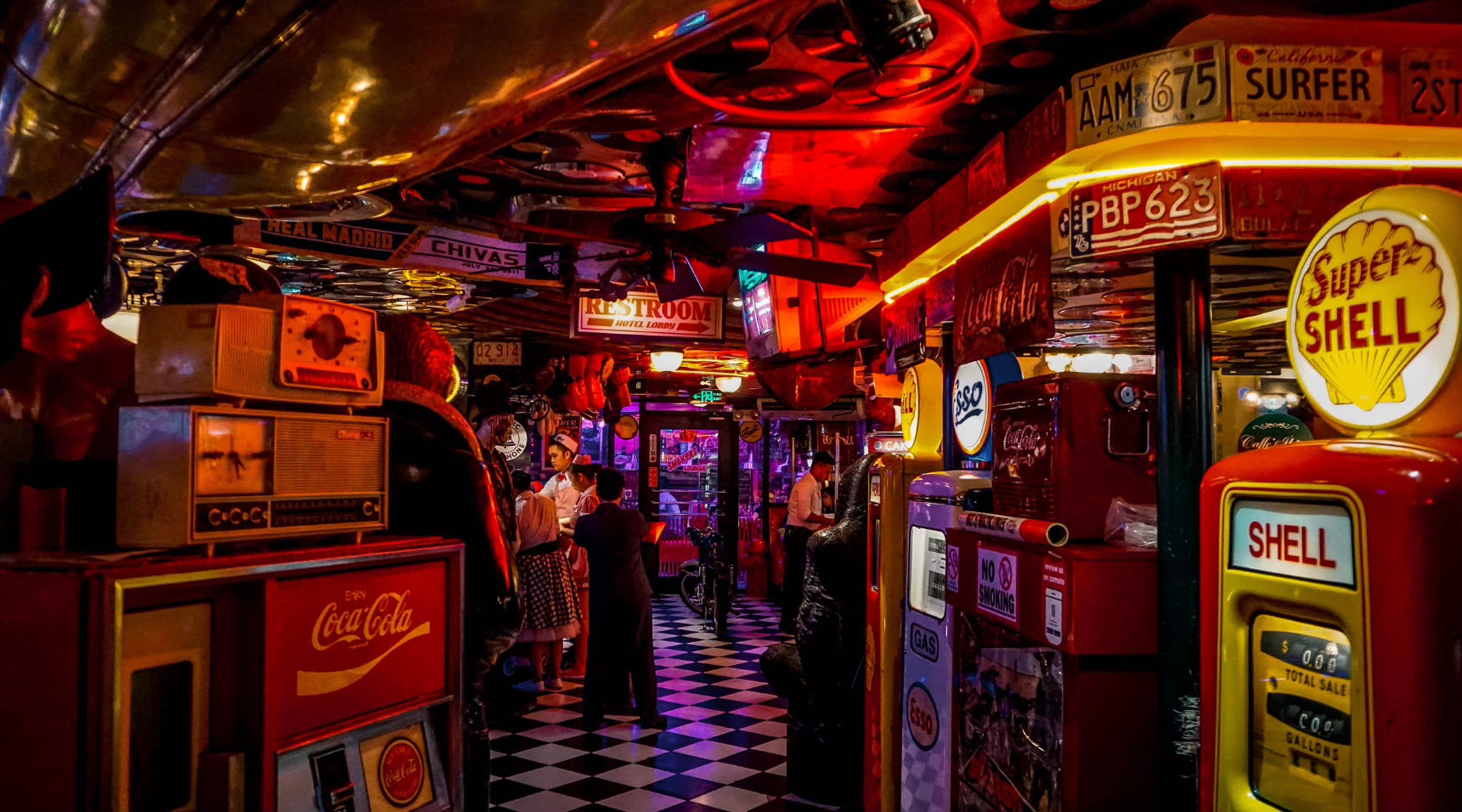
When Bullshit Hunting was created, I thought a lot about The Third Place. It was something Justin and I were talking about. The loss of cultural relics like the arcade, the mall, pool halls and internet cafes. Places with intention that didn’t require you to have your own. Our very own loitering infrastructure, climate-controlled and socially dense. As I mocked up the first designs for Weekend Weirdies, it’s what our imagery and tone were based around, a sense of nostalgia for times and places that felt simpler.
In 1989, sociologist Roy Oldenburg published The Great Good Place, which explored the idea that having places to hang out simply for the pleasures of good company and lively conversation is the heart of a community’s social vitality and the grassroots of democracy.
The idea is simple. Your “first place” is your home and the people you live with. Your “second place” is your workplace, where many people spend most of their waking time. Finally, Third Places are the “anchors” of community life that give us space to foster broader, more creative connections. In other words, “your Third Place is where you relax in public, where you encounter familiar faces and make new acquaintances.”
The seven characteristics of a Third Place are:
Open and inviting.
You don’t need an invitation or appointment, and you can come and go as you please.
Comfortable and informal.
You feel that you belong.
Convenient.
It’s close enough to visit often, ideally in your own neighbourhood.
Unpretentious.
Everyone is on the same level, there’s nothing fancy or fragile, and it’s not expensive.
There are regulars.
And, often, a host who greets people as they arrive.
Conversation is the main activity.
Discussion, debate, and gossip are part of the mix.
Laughter is frequent.
The mood is light-hearted and playful. Joking and witty banter are encouraged.
If there’s a low barrier to entry, no significant cost, and it offers stress relief from both home and work, and a sense of belonging, that’s a Third Place.
You can think of classic places like bars, coffee shops, community centres, parks.
Since Oldenburg’s work, though, people have argued that third places are increasingly migrating online. Virtual communities can reproduce certain Third Place characteristics: social levelling, regulars, conversation with informal moderation.
This, I’m at odds with.
Third Places aren’t gone, but like many things these days, they’re collapsing inward. Social lives are folding back into the spaces that remain, primarily the home. In a remote-work world, this means the first place absorbs the second and the third at once. Home becomes office, social hub, leisure space, and recovery zone. What used to be separated by distance and routine now happens on the same couch, often on the same device.
That collapse matters. Third places once acted as buffers. They were where people practiced being around others, not as colleagues, not as partners, not as faceless avatars. You didn’t have to be optimized, articulate, or productive. You just had to coexist. As those spaces disappear, people lose a low-risk environment for connection, the everyday practice of reading a room, tolerating difference, negotiating minor discomfort, and repairing small missteps.
Social negotiation is one of my favourite terms.
It’s the often unspoken process through which we adjust, trade, and manage parts of ourselves to belong. This shows as the things we decide to reveal or withhold in conversation, which opinions we soften, which desires we defer, and which roles we’re willing to step into in exchange for acceptance, stability, or ease. People learn, often implicitly, what is rewarded and what is risky in a given environment, and they shape themselves accordingly. They become agreeable instead of outspoken, useful instead of needy, humorous instead of vulnerable. These negotiations aren’t inherently negative or positive; they are simply how we learn to live in a momentary shared reality with others.
Very early studies have shown us that young people are losing their ability to socially negotiate. In a world where interaction is had online and not in the streets, not in playgrounds or out back behind the Blockbuster next to the garbage cans, there becomes a lost sense of order.
In grade school, I learned that I had some social cache because I had an older sister who was louder and scarier, and if you were mean to me on the monkey bars, she’d beat your ass at the second tree next to the soccer field. In high school, I had to learn the hard way that without that protection, I was actually just a 5-foot-nothing teenager with a loud mouth and no real drive to fight. I had to socially negotiate my way out of Kelly Stevens punching me in the face at a park party, and from there on out, I learned that sometimes, it’s ok to assume position in a hierarchy you might not like.
You see what I’m saying.
In digital environments, interaction is flattened and filtered. You can step out or in. If you can turn a microphone off, a camera off, close a computer or a tab, nothing is required of you
The result isn’t just loneliness; it’s social brittleness. People become less tolerant of ambiguity, less skilled at soft conflict, and more reactive. Without the steady, low-level exposure to difference, social muscles atrophy. When work, leisure, and social life all occur in the same space, boundaries erode. People are never fully off-duty, but also never fully present. Burnout intensifies, empathy thins. It’s harder to extend grace when you’re perpetually half-working, half-resting, and never arriving anywhere that doesn’t ask you to be something particular.
What my friend was pointing at, that afternoon in the heat, wasn’t the beer or the cigarettes or even the joy. It was the repetition. The same stool. The same table. The same orange cat. The same faces, showing up again and again, knowing they would be seen.
That bar didn’t exist because everyone there was making good choices, or because they needed to be there. It existed because it was there. Because it asked very little. Because you could arrive as you were, tired, drunk, lonely, late, and still be folded into the room. The owner didn’t have to be a role model to be a steady constant. He just had to open the doors and keep showing up. So did everyone else.
When he bent over that stroller, laughing in the middle of a Monday afternoon, he wasn’t performing happiness. He was practicing it, in public, in front of witnesses. In a place that would be there again tomorrow, and the day after that, whether he was charming or irritable or drunk or sober.
That’s the part we’re missing.
Not friendship or intimacy or even community, in the abstract. We’re missing the in-between space where none of those things are required, but all of them are possible. The place where you don’t have to schedule, explain, optimize, or retreat. Where your presence alone is enough to count, and you understand that you have a place.
When I got home, my condo was still clean and quiet and safe, just like I’d left it. My life was still well-constructed and cozy, and nice, but there was no barstool expecting me. No cat that belongs to no one. No man with sausage fingers who knows my face without knowing my story.
And I think that’s why that scene lodged itself somewhere between my amygdala and hippocampus. Not because I want his life, or his habits, or his ending, but because he had somewhere to be on a Monday afternoon that held him in place. Somewhere that let him be ordinary, and known, and briefly ridiculous, and loved anyway.
For a brief moment in time, that bar was my Third Place.
I think I’d like to find another one soon. I think you should, too.