

“Yo! I just found a whole bunch of Ed and Lorraine Warren stuff!”
Despite what one might think, this is not a strange way to start a conversation at Permanent Record Research. You’re always amongst friends when it comes to the occult, the demonologists and the fraudsters we make in between.
Like a DJ loves nothing more than sharing music, I love sharing new document finds. New creepy audio. Weird ass video that no one has seen before. I’m really good at it, too. Because I really love doing it.
So I thought I would share a bit of the process that I use for expanding our ever-growing library of occult, supernatural and — ahem — fraud encyclopedia at Permanent Record Research.
In particular, I want to highlight how to do it to chase demons.
Step 1: Find Old, Creepy Books
While I spend a significant amount of my time traipsing through online materials and using digital tools, it is in the old and the mould, where I find the best goodies.
Books. Real books.
Depending on your budget, this can range from small investments at your local thrift shops or used bookstores, all the way up to spending tens of thousands of dollars on esoterica. I’m in the tens of dollars range, and that offers ample discoveries.
My favourite site for this activity is abebooks.com as there is a network of rare book dealers, and specialists in the occult, the supernatural and everything else, it seems all under this one roof.
Step 2: Buy The Unrecognizable
My book criteria is simple: have I ever heard of this book before?
If not? Buy it.
I don’t mean have I read the book before, I mean have I even heard of it. I am truly trying to find the rarest, weirdest shit, so I don’t want any ringing bells of familiarity in my mind while I am doing so. So for research purposes, I want unrecognizable.
Starting with some simple searches around demonic possession and exorcisms, this gave me a great starting point on AbeBooks.com. Since I don’t have a large budget and shipping is a real wildcard currently, I was simply looking for a handful of books that were affordable, in decent shape, and unrecognizable.

Boomshalaka!
This beauty was added to the cart immediately. Just look at that dust cover. I can feel the stifling heat in that church basement; smell the sweat, the Rice Krispies squares and Pine-Sol.
Now stop.
Don’t keep looking for more books to add to the pile. The reason is that my method is meticulous, and even the thinnest volume can be months of research if you do it the way I prefer.
That’s right. Months.
While I may mow through a number of books for leisure in the same time, when you’re hunting demons and exorcists, you gotta take it slow.
Hit that order button and wait for your new find to arrive in the mail.
Step 3: Read Like a Researcher
The doorbell rings. The dogs bark. It’s book delivery day, baby, and the race is on.
While this level of excitement is encouraged when retrieving the book from your front step, it most definitely is not the energy you want to bring to reading the thing. You’re gonna calm down, take a deep breath, and grab your notebook1. Perhaps a cleansing fart to ease any lingering tension.
Write down the book title, the edition, author, the date. All of that jazz.
And now read every word.
I mean it. All the words. All them words.
Table of contents. Foreword. Backward. Read the upward2.
Every chapter heading, footnote, and bibliographical reference. As you are doing so, there should be one trigger or bell that rings in your head as you go. One little blip on your radar that should cause your pen to breakdance across your page.
Do I know anything about this person or place that I just read?
If the answer is “no”?
You stop. No more reading for you.
You may have made it no further than the author’s introduction, or perhaps the name of the person who wrote the foreword. There’s a reason that person is writing that foreword, or is otherwise named in the book.
So let’s stop, drop and doodle.
Step 4: Drawing a Graph
In my case, I had not heard of a Father Alphonsus Trabold, so, following my "Stop. Drop. And Doodle” rule, I added him to my notebook and headed to excalidraw.com. I then drew the simple diagram shown in Figure 2.
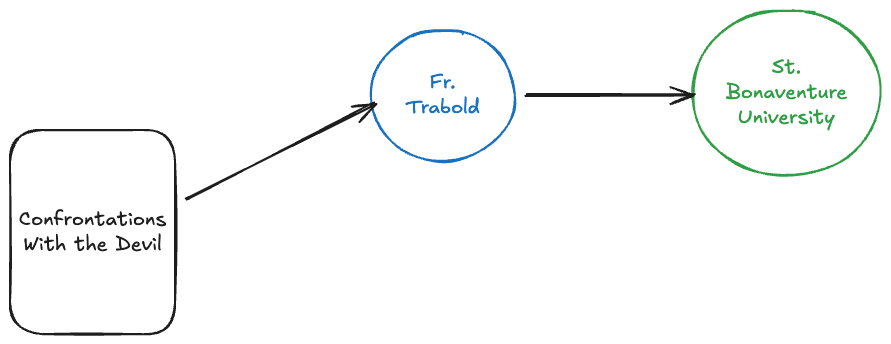
Not too fancy, right?
Don’t let those sticks and balls fool you! They’re powerful.
They are summarizing what we know with a very small amount of information.
The graph shows what we know so far, and how people, places and things are related to one another. This is a critical part of any research process. Particularly so when we are hunting the who, what, where, when and why of demonic possession and poltergeists.
Speaking of, it’s not time to return to reading our book of sweaty sermons quite yet. We still don’t know anything about Trabold or St. Bonaventure University.
Let’s take a quick tour to New York, shall we?
Step 5: Do Your Research
Some call them rabbit holes. I call them bunny tunnels. Either way, they’re often used as a derogatory term, or some kind of self-deprecating humour when we’ve lost an afternoon to the bowels of YouTube and a Vyvanse shortage.
Always seemed weird to me, since we do have to dig… at least a little.
Dig I did. One search with Kagi and lo and behold, the archives of Father Alphonsus Trabold at St. Bonaventure University.
This included a page dedicated to Paranormal Cases, a gallery of photographs, and a link to Fr. Trabold’s archives. The archive page includes a 100-plus-page scan of Fr. Trabold’s lecture notes that furnishes an incredibly detailed history of spiritualism and the occult, among other oddities.
However, it was not Trabold’s notes I was interested in. What caught my eye was in Box 3. Ed and Lorraine Warren. The Warrens are the famed demonologist-psychic, husband-wife duo of The Conjuring, The Amityville Horror and a host of other pop-culture hauntings. Further down the page, it appears there are even some audio and video records that might be available.
After a handful of emails back and forth with St. Bonaventure archivists, these wonderful folks sent me a handful of audio and video files and some correspondence from Box 3. Including what appeared to be an urgent message from Lorraine Warren to Father Trabold on November 24, 1974.

Well, I don’t know what case the Warrens were working on at the time, but that’s a research question for another day. I update my graph again, and now it looks something like Figure 3.
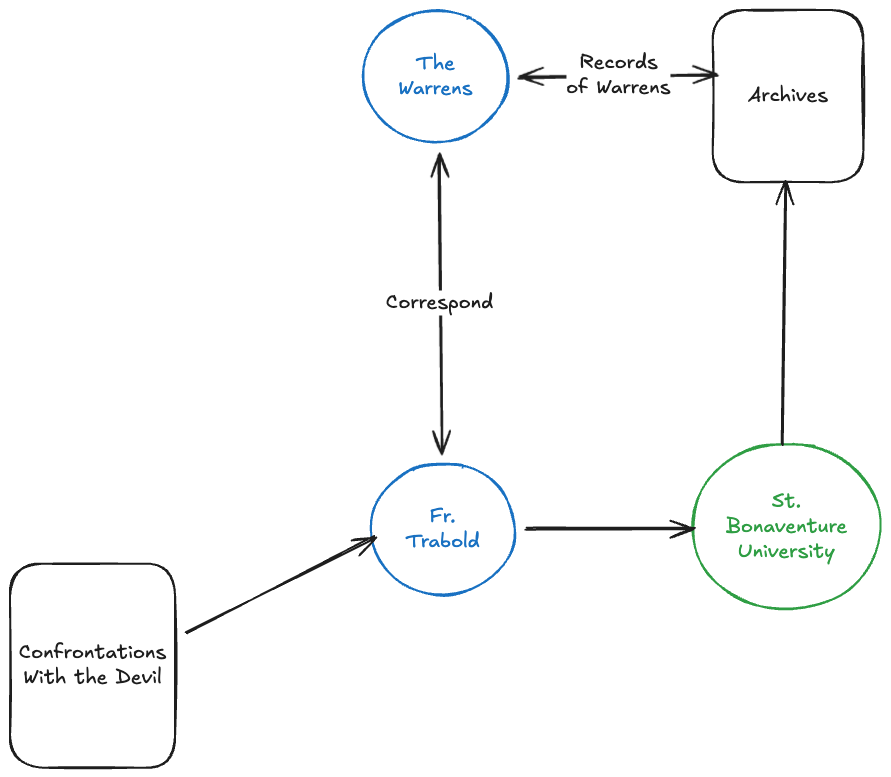
This process of curious discovery, meticulous note-taking, and of course — doodling — will take you to places you rarely anticipate going. Every book has its own spiderweb of connections outward. Every university archive, dusty church basement box, and weird-book-find online is an opportunity to dig deeper than other folks chasing the same facts.
I’ve waxed poetic regarding this concept of “Thinking in Graphs” before and have even dedicated an entire chapter to it in my (seemingly never-ending) next title with No Starch Press.
This process works whether you’re chasing terrorists, chasing murder or chasing ghosts.
Let me know what you find.
I am so fortunate, as an ADHD person, to have a Remarkable 2 Pro and I can’t recommend these devices enough. I may wax poetic in an entire post on how the Remarkable series has changed my note taking and investigative work. Truly can’t give these things enough stars.
Not a thing.